
Cold Cranking Amps (CCA) is a critical rating that measures a battery’s ability to start an engine in freezing temperatures. Understanding this figure ensures you choose the right power source to keep your vehicle reliable throughout the harsh winter months.
If you have ever spent a chilly morning in 2026 staring at your dashboard while your car refuses to turn over, you have likely encountered the real-world consequences of a low-performance battery. When we shop for automotive power, we often see a mysterious three-letter acronym printed on the label: CCA. But what does CCA mean on a battery, and why does it seem to matter so much when the frost sets in?
At its core, CCA or Cold Cranking Amps is the lifeblood of your vehicle’s startup process. Think of it as the muscle your car uses to push through the resistance of cold engine oil and frozen mechanical parts. If you have ever wondered why your car starts easily in July but groans in January, the CCA rating is the primary answer to that puzzle.
Key Takeaways
- Definition of CCA: It stands for Cold Cranking Amps, representing the current a battery can deliver at 0°F for 30 seconds while maintaining a specific voltage.
- Importance of Temperature: CCA is specifically designed to test battery performance under extreme cold, where engine oil thickens and starting power needs are high.
- Vehicle Requirements: Always check your owner’s manual for the manufacturer’s recommended CCA rating to avoid starting failures.
- Climate Sensitivity: If you live in a region with sub-zero temperatures, you should prioritize a higher CCA rating for better reliability.
- Maintenance Matters: A battery with a high CCA rating can still fail if it is not properly charged or if terminal connections are corroded.
- More Isn’t Always Better: While exceeding the minimum CCA is safe, paying for massive power you don’t need is an unnecessary expense.
Understanding the Basics of Cold Cranking Amps
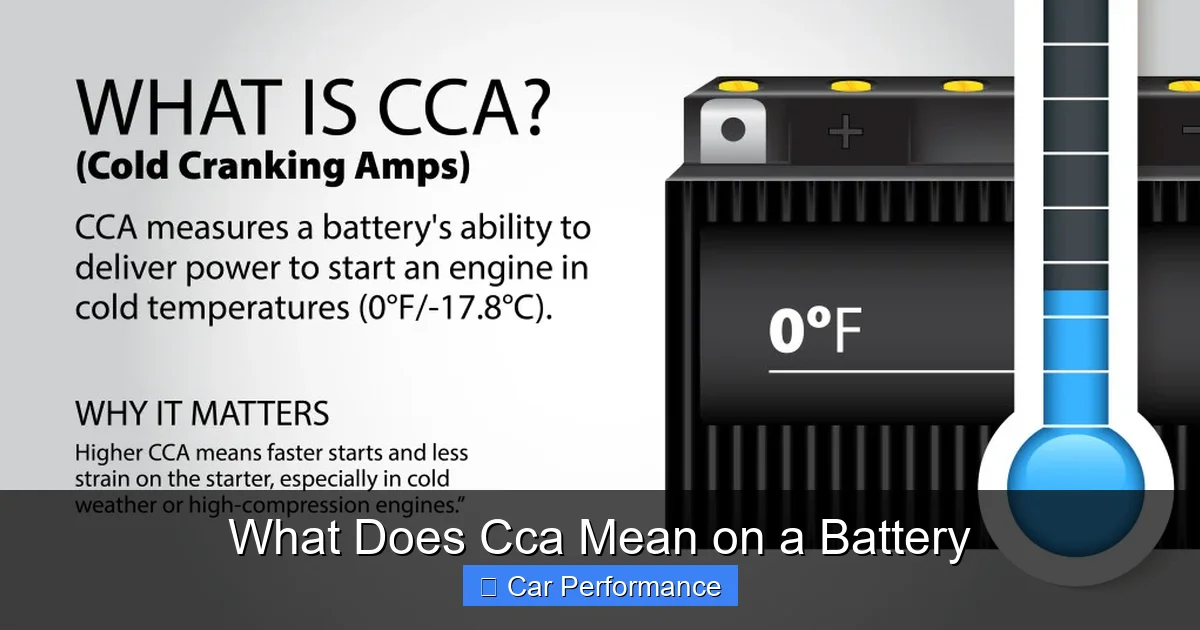
So, let’s get down to the technical details without the headache. The rating itself is standardized. It measures the number of amps a 12-volt battery can deliver at 0°F (-18°C) for 30 seconds while maintaining a voltage of at least 7.2 volts. This is a rigorous test that mimics the hardest task a battery will perform all year: starting your engine on a frigid morning.
Why Cold Weather Changes Everything
Physics is the reason your car struggles in the winter. When temperatures drop, two things happen inside your engine. First, the motor oil inside your engine block becomes thicker and more viscous, like honey on a cold day. This makes it significantly harder for the starter motor to turn the engine over.
Second, the chemical reactions inside your car battery slow down drastically in the cold. A battery is essentially a giant chemical reactor. When it gets cold, those chemical reactions become less efficient. This means your battery has less raw power available at the exact moment your engine needs it the most. That is why the CCA rating is the most important metric for drivers in colder climates.
Decoding the Rating on Your Battery
When you look at the top of your battery, you will see a number next to the letters CCA, such as 600 CCA or 800 CCA. This tells you the discharge capability. A higher number means the battery has more raw power to spin the starter motor. If your car requires 600 CCA to start reliably, installing a 400 CCA battery would likely lead to a dead start during the first deep freeze of the year.
Choosing the Right CCA for Your Vehicle
Many drivers in 2026 fall into the trap of thinking that bigger is always better. They assume that if a 700 CCA battery is good, a 1000 CCA battery must be even better. While it is true that having extra CCA won’t harm your car, it isn’t always the most cost-effective choice.
Visual guide about What Does Cca Mean on a Battery
Image source: yuasabatteries.com
Consulting the Owner’s Manual
Your manufacturer spent thousands of hours testing your specific engine to determine exactly what it needs. The owner’s manual will list the minimum CCA requirement for your vehicle. It is generally wise to meet or slightly exceed this number. If you live in a location where the temperature rarely drops below freezing, you may not need the highest CCA rating available on the shelf.
When to Upgrade Your CCA
However, there are exceptions. If you have added aftermarket accessories, such as a high-powered stereo system, auxiliary lights, or a winch, your electrical demands are higher. In these cases, opting for a battery with a higher CCA rating provides a healthy safety margin. It ensures that even if your battery is not at 100% charge, it still has enough “oomph” to get you on the road.
The Science of Battery Health and Longevity
Knowing what CCA means on a battery is only half the battle. You also need to understand how to maintain that capacity over time. A high-quality battery with a great CCA rating won’t do you much good if you don’t take care of it. Batteries lose their ability to hold a charge as they age, and their effective CCA will naturally drop over the years.
The Impact of Short Trips
One of the biggest killers of battery health in 2026 is the habit of taking very short drives. When you start your car, the starter motor draws a massive amount of power. It takes about 20 to 30 minutes of driving for the alternator to fully replace that energy.
If you only drive for five minutes to get to the store, your battery is constantly being drained without being replenished. Over time, this leads to sulfation a buildup of lead sulfate crystals – which permanently lowers your battery’s CCA.
Regular Testing and Maintenance
In the modern age of advanced diagnostics, you don’t have to wait for your car to fail. Most auto parts stores offer free battery testing. They use a handheld device that calculates the remaining CCA. If your battery is rated for 600 CCA but tests at 300, it is time for a replacement before you get stranded. Keeping your terminals clean of corrosion also ensures that the power you have is actually reaching the starter.
Myth-Busting: CCA vs. Other Battery Ratings
It is easy to get confused by the wall of jargon in the battery aisle. Besides CCA, you might see terms like CA, HCA, or RC. Let’s clear those up so you know exactly what you are paying for.
CA (Cranking Amps)
Cranking Amps measures the same discharge capability but at a warmer temperature of 32°F (0°C). Because it is warmer, the number will always be higher than the CCA. Do not confuse the two! If a battery box says “800 CA” in big, bold letters, check the small print. It might only be 600 CCA. Always rely on the CCA rating for winter performance.
RC (Reserve Capacity)
Reserve Capacity measures how long your battery can run your car’s electrical system if the alternator fails. It is measured in minutes. While CCA is all about starting the engine, RC is about keeping the car running until you can find help. Both are important, but they serve very different purposes.
Real-World Tips for Winter Preparedness
As we navigate the winter months in 2026, being proactive is the best way to avoid a dead battery. If you live in a climate where temperatures drop below freezing, consider these practical steps to protect your vehicle’s starting power.
Keep Your Battery Warm
It sounds strange, but if you have access to a garage, park your car inside. Even a non-heated garage stays significantly warmer than the open air. This keeps the battery’s internal chemistry closer to its optimal range, ensuring your CCA is ready for action the moment you turn the key.
Invest in a Battery Maintainer
If you have a vehicle that sits idle for long periods, like a classic car or a second vehicle, use a “trickle charger” or battery maintainer. These devices keep the battery at a constant, healthy charge level. By preventing the battery from dropping into a low-charge state, you stop the sulfation process, effectively preserving that crucial CCA rating for when you need it most.
Conclusion: Powering Your Journey
To wrap things up, understanding what CCA means on a battery is one of the best ways to become a more informed car owner. It is not just a random number on a sticker; it is the metric that guarantees your morning routine remains uninterrupted by the cold.
By checking your manual, understanding your local climate, and maintaining your battery health, you ensure that your vehicle stays reliable throughout the year. In 2026, technology continues to improve, but the basic chemistry of lead-acid and AGM batteries remains tied to temperature.
Respect the CCA rating, monitor your battery’s health periodically, and you will find that even the coldest winter days won’t stop you from reaching your destination. Stay charged, stay warm, and keep your engine turning over with confidence.
Frequently Asked Questions
What does CCA stand for?
CCA stands for Cold Cranking Amps. It is a measurement used to define a battery’s ability to start an engine in cold temperatures, specifically at 0°F.
How much CCA do I need for my car?
You should always consult your vehicle’s owner’s manual to find the manufacturer’s recommended rating. Generally, choosing a battery that meets or slightly exceeds this minimum is the best practice for reliability.
Can I use a battery with a higher CCA than recommended?
Yes, you can safely use a battery with a higher CCA rating than the manufacturer suggests. It will not damage your electrical system and may provide extra starting power in extreme weather.
What happens if my CCA rating is too low?
If your battery’s CCA rating is too low for your engine’s requirements, your car may struggle to start, particularly on cold days. Eventually, the battery will be unable to turn the starter motor, leaving you with a dead vehicle.
Is CCA the same as Cranking Amps (CA)?
No, they are different. Cranking Amps are measured at 32°F, while Cold Cranking Amps are measured at 0°F. Always look for the CCA rating to ensure your car will start in freezing conditions.
How often should I check my battery’s CCA?
It is a good idea to have your battery tested once a year, especially before the winter season begins. Most auto parts stores perform this test for free to ensure your battery is still performing to its rated capacity.