
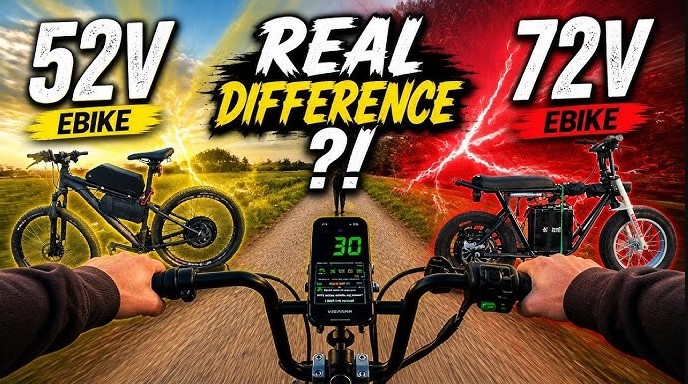
While a 72v motor can technically spin when connected to a 52v battery, it will result in significantly reduced power, torque, and top-end speed. This mismatch creates inefficiency and potential controller errors, making it an impractical setup for most high-performance electric vehicles.
If you are tinkering with electric vehicles in 2026, you have probably found yourself staring at a pile of parts wondering how to make them talk to each other. One of the most common questions we see in the garage is, “Can a 72v motor work with a 52v battery?” It sounds like a simple swap, but as we dive into the world of electric propulsion, we quickly learn that electricity is a bit more demanding than just matching up wires.
When you look at a 72v motor, it was engineered to perform at a specific energy level. When you feed it a lower voltage like 52v, you are basically asking a marathon runner to sprint with a heavy backpack. Sure, they might move, but you are not getting the performance you paid for. Let’s break down the science, the risks, and the reality of this common electric vehicle mismatch.
Key Takeaways
- Voltage Mismatch: Using a 52v battery on a 72v motor drastically lowers the RPM and overall torque output.
- Controller Compatibility: Most 72v controllers have low-voltage cut-off settings that will prevent the system from starting with a 52v battery.
- Efficiency Loss: Running a system below its design voltage leads to higher current draw (Amps) to compensate for the lack of punch.
- Heat Issues: Higher current draw can lead to excessive heat buildup in your wiring and motor windings.
- Performance Trade-offs: You will sacrifice speed for range, though the system will likely feel sluggish and unresponsive.
- Safety First: Always verify your controller’s voltage range before attempting to mix power sources to avoid permanent damage.
The Relationship Between Voltage and Motor Performance
To understand why this is a tricky situation, we need to look at how a motor actually “sees” electricity. Voltage is effectively the “pressure” that pushes current through your motor. A 72v motor is built to handle that high pressure to create the magnetic fields necessary for high-speed rotation and high torque.
What happens when you drop the pressure?
When you drop from 72v to 52v, you are reducing the electrical pressure by nearly 30 percent. In the world of DC motors, voltage is directly linked to the top speed of the motor. A motor has a “KV rating,” which stands for RPM per volt.
If you reduce the input voltage, your motor will simply not be able to spin as fast as it was designed to. You will notice this immediately as a sluggish takeoff and a top speed that feels like it has been capped.
The torque dilemma
Torque is the “grunt” that gets you moving from a dead stop. While voltage dictates speed, current (Amps) usually dictates torque. However, because the motor is designed for higher voltage, it may struggle to reach its peak efficiency. You might find that your vehicle feels “weak” or “dead” at certain speeds because the motor is essentially operating outside of its intended power band.
Controller Compatibility and Logic
The biggest hurdle you will face is not the motor itself, but the brain of your electric vehicle: the controller. Most 72v motor controllers are programmed with something called a Low-Voltage Cut-off (LVC). This is a safety feature designed to protect your batteries from being drained to a point where they get damaged.
The LVC issue
If your controller is set to a 72v standard, it likely has an LVC programmed somewhere around 60v to 63v. If you plug in a 52v battery, the controller will look at the battery, see 52v, and immediately think, “Oh no, the battery is almost dead!” The controller will likely refuse to turn on, or it will shut down the moment you touch the throttle. Can a 72v motor work with a 52v battery? Usually, the controller says “no” long before the motor gets a chance to try.
Programmable Controllers
If you are using a high-end programmable controller, you might be able to manually lower the LVC threshold to accommodate 52v. While this solves the “will it turn on” problem, it does not solve the underlying performance issues. You are essentially tricking the system into operating in a degraded state.
Understanding the Current Draw and Heat
Physics dictates that if you want a certain amount of power, you need a specific combination of volts and amps. Power is defined as Watts (Volts x Amps). If you lower the voltage but want to maintain the same power output, you must increase the amperage.
Why high amps are dangerous
When you draw more amps than a system is designed for, you create heat. Excessive heat is the number one killer of electric motors and battery connectors. If you force your 72v motor to pull extra current to try and match the performance you were expecting, you might end up melting connectors, damaging your battery’s internal BMS (Battery Management System), or even burning out the phase wires.
Long-term stress
Even if nothing melts immediately, running a system at high amps and lower voltage leads to accelerated wear. You are putting extra strain on the internal components. In 2026, we have better diagnostic tools than ever, and these tools will show you that a mismatched system runs significantly hotter than a balanced one.
Efficiency and Range Considerations
One might think, “Well, if I am going slower, at least I will have more range, right?” Not necessarily. An electric motor has a “sweet spot” for efficiency. When you run it at a much lower voltage than it was designed for, you are operating at lower efficiency levels.
The efficiency drop
You may find that you are using just as much energy to travel the same distance because the motor is struggling to maintain its rotational efficiency. Instead of getting a smooth, efficient glide, you are pushing the motor to compensate for the lack of voltage. This negates the range benefits you might have hoped for by using a smaller battery pack.
Real-world riding
If you are riding a scooter or an e-bike, you will notice that the “sag” on your battery becomes more pronounced. As you accelerate, the voltage drops further. With a 52v pack, you might be dipping into the 40-volt range under load, which is way outside the comfort zone for a system designed for 72v. The ride experience will feel “mushy” and inconsistent.
When Might You Actually Try This?
Is there any situation where this makes sense? Perhaps you are in a temporary jam, or you are testing a motor to see if it spins before you buy a full 72v pack. If you are doing this as a proof-of-concept for a bench test, it is fine.
Bench testing
If you just want to see if the motor spins, or if you are checking the wiring configuration, a 52v battery is perfectly safe for a brief test. You aren’t going to blow anything up by just spinning the motor without a load. Just keep the test brief and don’t expect actual performance.
The “Limiting” approach
Some builders use lower voltage batteries to limit the top speed of a vehicle for children or beginners. However, this is a poor way to do it. It is much safer to use a controller with a “speed limit” setting or a “gear” setting that limits the current/RPM via software, rather than intentionally using an incompatible, underpowered battery pack.
Safety Warnings and Best Practices
Working with high-voltage electricity is not a hobby to take lightly. Even 52v can be dangerous, and 72v packs are powerful enough to cause significant arcing and severe electrical burns. When experimenting with power systems, keep these tips in mind.
- Always use the correct charger for your specific battery chemistry.
- Check all electrical connections for signs of heat or melting.
- Ensure your wiring gauge (thickness) is sufficient for the current you are pulling.
- Never bypass safety protections like fuses or circuit breakers.
- If you must mix voltages, always check the voltage range on the controller label.
In 2026, the technology for electric motors has become very sophisticated. Most modern controllers are very smart. They monitor voltage in real-time and will protect you from yourself. If you are ever unsure, it is always better to stick to the recommended voltage for your motor and controller. The cost of a new battery is almost always less than the cost of a fried controller or a damaged motor.
Conclusion
So, can a 72v motor work with a 52v battery? Technically, yes, in the same way that you can drive a car with a flat tire. It will move, but you will not enjoy the ride, you will likely damage your equipment, and you are not getting the best out of your gear.
For the best performance and longevity of your electric vehicle, it is always better to match your motor, battery, and controller voltages. If you are looking for more power, upgrade your battery to match the motor’s design. If you need more range, look into higher amp-hour (Ah) batteries at the correct voltage. Keep it matched, keep it safe, and you will enjoy many years of trouble-free riding.
Frequently Asked Questions
Will using a 52v battery damage my 72v motor?
Generally, no, the motor itself will not be damaged by a lower voltage. However, the controller or the battery’s internal components could be stressed or damaged due to higher current draws required to compensate for the lower power.
Why does my motor feel so slow with this setup?
A motor’s top speed is directly proportional to the voltage supplied. By dropping from 72v to 52v, you have physically limited the maximum RPM the motor can reach, resulting in significantly lower top speeds.
Can I just change the controller settings to make it work?
If you have a programmable controller, you can lower the Low-Voltage Cut-off (LVC) to prevent the system from shutting down. However, this is only a software fix and does not solve the physical performance loss caused by lower voltage.
Is it dangerous to mix these voltages?
The danger lies primarily in the increased heat generated by the current draw. If your wiring is not rated for the higher amps needed to maintain power, you risk melting insulation and potentially causing a fire or short circuit.
How do I know what voltage my motor needs?
Check the label or documentation provided with your motor. Most high-performance motors are stamped with a rated voltage range; always aim to stay within that specific range for optimal performance.
What happens if I try to go uphill with this setup?
Going uphill requires high torque and steady power. Since your system is under-voltaged, it will likely struggle, draw excessive current, heat up rapidly, and potentially trigger your controller’s thermal protection or shut down entirely.